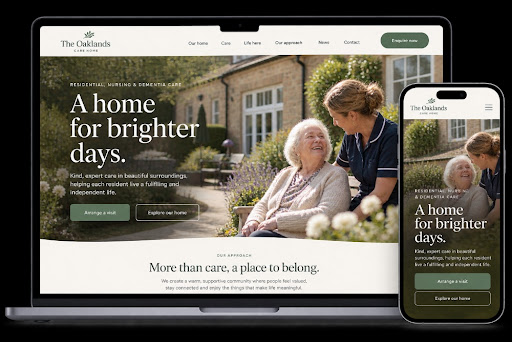
Built for real care businesses, not generic templates.
Practical decisions, clear scope, considered design and reliable information.
Designed for how care is actually chosen
In Josh’s experience managing care homes, families often first heard about a home through a directory, a social worker, a professional recommendation or somebody they trusted. The website was where they went next to understand the place and decide whether to get in touch.
That shapes our care home website design: show the people, daily life, care provision and practical information behind the recommendation. Make it easy to ask a question or arrange a visit, without expecting the website to replace a helpful conversation.
A single home, a care group or a home care agency
- For a single care home, help families picture one place: accommodation, shared spaces, daily life, the care genuinely available and the people who handle visits and enquiries.
- For a care group, give each home its own identity, current information and enquiry route. Keep shared explanations central where useful, while making each home’s location, care provision and team clear.
- For a domiciliary or home care agency, explain support in people’s own homes, actual service areas and the office responsible for enquiries. Separate care enquiries from recruitment, and do not imply that every town has a branch.
We plan those differences before choosing layouts. The aim is a structure your team can keep accurate, rather than extra pages for every keyword variation.
Show the care you actually provide
Real photographs of rooms, gardens, activities and everyday interactions help explain what a visit might feel like. We review your existing images, what is missing and your permission to use them. If genuine material is not ready, we can discuss clearly illustrative stock imagery and an agreed plan to replace it; stock must not be presented as your people or premises.
People profiles can make the enquiry team approachable when the provider supplies and approves names, responsibilities, biographies and photographs with appropriate permission. A named contact invitation can still reach a central inbox: the important part is that somebody owns the response.
A website that sounds like your organisation
Some providers say “residents”; others prefer “people who live here”. Some use “staff”, while others describe their team differently. We ask about your language and culture rather than impose the same wording on every home.
You approve descriptions of care, fees, funding information and service availability. Where website information and directory listings disagree, we flag the discrepancy for a factual decision. Funding arrangements vary by provider and local authority; the website should explain your own process without promising eligibility or care suitability.
Website design and redesign
We plan the structure, page journeys and copy, then design responsive layouts and build the website. Projects can be a new site or an improvement to something already online.
We consider mobile usability, accessible navigation, readable text and contrast, labelled forms, practical loading performance and sensible on-page search foundations. Existing useful pages and URLs are reviewed before a redesign; any necessary URL changes need a redirect plan.
What is included?
An agreed project scope can include discovery with the owner, director or nominated lead; a page and content plan; design and development; content refinement; and testing before launch. We identify what your team supplies, what we prepare and who approves it.
You approve service details, photography and any sensitive or regulated information. We agree deliverables, hosting, access, ownership and handover before work begins; we do not assume an unlimited content or development scope.
From the brief to launch
First, we understand your service and what families need to know. Then we map the pages and agree the content. After design and development, we test navigation, forms and the experience on smaller screens.
Enquiry testing includes checking the receiving process with your team, the right home or office destination and what happens when a submission fails. Before briefing a build, use the care website checklist to review family information, accessibility and enquiry delivery.
What happens after launch?
Your website can be handed over for your team to run, with access and responsibilities agreed for the chosen platform. Alternatively, website management can support approved updates when teams, care services or contact arrangements change.
If growing organic visibility is the next challenge, our SEO and local search support can be scoped separately. Neither ongoing service is a compulsory add-on to a website build.